Lean Six Sigma was developed in massive corporations—GE, Motorola, Toyota. The full-scale methodologies assume dedicated Black Belts, months-long projects, and statistical resources most SMEs don't have. But the principles are universal. This guide shows how to extract the value without the bureaucracy.


The SME Challenge: Limited Resources, Unlimited Waste
Small and medium enterprises face a paradox:
- They have more waste per employee than large corporations (less process discipline, informal systems, firefighting culture)
- They have fewer resources to tackle it (no dedicated improvement teams, limited capital, stretched management)
Traditional Lean Six Sigma programmes fail in SMEs because:
- They're too slow. A 3-month DMAIC project is an eternity when you're managing cash week-to-week.
- They're too resource-intensive. Training 20 Green Belts and 5 Black Belts is unrealistic when headcount is tight.
- They're too bureaucratic. Tollgates, steering committees, and 50-page project reports create overhead SMEs can't afford.
The solution? Strip Lean Six Sigma down to its core principles, adapt the tools, and accelerate the pace.
Lean vs. Six Sigma: Know the Difference
Lean and Six Sigma address different problems. SMEs should deploy each where appropriate, not force-fit one methodology to everything.
Lean: Eliminate Waste, Accelerate Flow
Origin: Toyota Production System
Focus: Speed, flow, waste elimination
Best for: Process efficiency, reducing lead time, inventory management
Core Principles:
- Identify value from the customer's perspective
- Map the value stream and eliminate non-value-added steps
- Make work flow smoothly without interruptions or queues
- Pull production based on demand (not push based on forecast)
- Continuously improve towards perfection
When to Use Lean: When the problem is process inefficiency, long lead times, or visible waste (waiting, motion, overproduction).

Six Sigma: Reduce Variation, Improve Quality
Origin: Motorola, GE
Focus: Quality, consistency, defect reduction
Best for: Quality problems, defect reduction, process control
Core Methodology (DMAIC):
- Define: Problem statement, scope, goals
- Measure: Current performance, data collection
- Analyse: Root cause identification using statistical tools
- Improve: Implement solutions, test effectiveness
- Control: Sustain gains, monitor performance

When to Use Six Sigma: When the problem is quality defects, process variability, or customer complaints about consistency.
Lean Six Sigma: The Hybrid Approach
Most real-world problems benefit from combining both:
- Use Lean to eliminate obvious waste and speed up flow
- Use Six Sigma to diagnose and fix quality issues
For SMEs, the 80/20 rule applies: 80% Lean (fast, intuitive, high-impact), 20% Six Sigma (where data-driven rigour is needed).
The Right-Sized Lean Six Sigma Toolkit for SMEs
Here are the highest-value tools, stripped of complexity:
1. Value Stream Mapping (Lean)
What It Is: A visual map of all steps (value-adding and non-value-adding) in a process from start to finish.
Why It Works for SMEs: Fast (1-2 days to map a process), visual (easy to communicate), and immediately exposes waste.
How to Do It:
- Pick a process to map (e.g., order-to-delivery, production flow)
- Walk the process with frontline staff, documenting every step
- Record cycle times, wait times, and defect rates at each step
- Classify steps as value-adding (customer pays for this) vs. non-value-adding (waste)
- Draw future-state map eliminating or reducing waste
Quick Win Example: A packaging SME mapped their order-to-delivery process and discovered orders sat in a "pending approval" queue for 3 days on average—pure waste. Delegating approval authority to shift supervisors cut lead time by 40%.

2. 5S (Lean)
What It Is: A workplace organisation method to create clean, efficient, safe work environments.
The 5 Steps:
- Sort: Remove unnecessary items
- Set in Order: Organise essentials for easy access
- Shine: Clean and inspect
- Standardise: Create visual standards and checklists
- Sustain: Maintain discipline through audits and accountability
Why It Works for SMEs: Low-cost, immediate impact, builds culture of continuous improvement.

Quick Win Example: A fabrication shop implemented 5S in their tooling area. Time spent searching for tools dropped from 45 minutes/day to under 5 minutes. Annual time savings: 160 hours per technician.
3. Pareto Analysis (Six Sigma)
What It Is: The 80/20 rule—80% of problems come from 20% of causes. Pareto charts visualise this to focus effort on high-impact issues.
How to Use It:
- Collect data on defects, complaints, or downtime causes
- Rank by frequency or cost
- Plot as a bar chart with cumulative line
- Focus improvement efforts on the top 2-3 causes
Quick Win Example: A food manufacturer tracked quality defects for one month. Pareto analysis revealed 68% of defects came from one packaging line. Focusing on that single line reduced overall defect rates by 50%.
4. Fishbone Diagram / 5 Whys (Six Sigma)
What It Is: Root cause analysis tools to dig beyond symptoms and identify underlying problems.
Fishbone (Ishikawa) Diagram: Categories causes into buckets (Methods, Machines, Materials, Manpower, Measurement, Environment) and maps contributing factors.
5 Whys: Ask "why" repeatedly (typically 5 times) to drill down to root cause.
Example:
- Problem: Machine downtime
- Why? Bearing failure
- Why? Inadequate lubrication
- Why? Lubrication schedule not followed
- Why? No checklist or accountability
- Why? Maintenance system relies on memory, not process
- Root Cause: Lack of preventive maintenance system
5. Kanban (Lean)
What It Is: A visual system to control work-in-progress (WIP) and signal when to produce or replenish.
Why It Works for SMEs: Simple, visual, reduces inventory and overproduction without complex MRP systems.
Quick Implementation: Use physical cards or coloured bins to signal when to produce the next batch or reorder materials. When bin is empty, trigger replenishment.
6. SMED (Single-Minute Exchange of Dies) – Lean
What It Is: A methodology to reduce changeover times (switching between products or jobs).
Why It Matters: Long changeovers force large batch sizes, increasing inventory and reducing flexibility.
How to Apply It:
- Separate internal activities (must be done whilst machine is stopped) from external (can be done whilst running)
- Move as many tasks as possible to external
- Simplify and standardise internal tasks
- Use quick-release mechanisms, pre-staging, and checklists
Quick Win Example: A plastics manufacturer reduced mould changeover from 4 hours to 45 minutes by pre-heating moulds externally and using quick-clamp systems. This enabled smaller batches and faster customer response.
The Right-Sized Improvement Programme for SMEs
Forget 6-month Black Belt projects. Here's a pragmatic approach:

Phase 1: Quick Wins (Weeks 1-4)
Goal: Build momentum and credibility fast.
Actions:
- Implement 5S in one area (warehouse, production floor, office)
- Conduct Gemba walks (go see, observe waste firsthand)
- Run one value stream mapping workshop
- Identify and implement 3-5 quick wins (no-cost or low-cost improvements)
Outcome: Visible improvements, employee engagement, proof that this works.
Phase 2: Targeted Projects (Months 2-4)
Goal: Tackle 2-3 high-impact problems using DMAIC-lite.
Actions:
- Select projects based on ROI (defect reduction, downtime reduction, lead time improvement)
- Assign project owners (doesn't need to be full-time—allocate 4-8 hours/week)
- Use simplified DMAIC: Define problem, measure baseline, analyse root causes (Pareto, fishbone), implement solution, track results
- Keep projects short: 4-8 weeks, not 6 months
Outcome: Measurable results (£50k-£200k savings typical for SMEs), capability building.
Phase 3: Build Continuous Improvement Culture (Ongoing)
Goal: Embed improvement as "how we work," not a special initiative.
Actions:
- Establish daily or weekly huddles to review KPIs and identify issues
- Create visual management boards (performance metrics, improvement projects, actions)
- Train frontline staff in basic Lean tools (not formal Green Belt—just practical workshops)
- Recognise and celebrate improvements (small wins matter)
- Make improvement part of performance reviews
Outcome: Self-sustaining improvement engine, not consultant-dependent.

Avoiding the Common SME Pitfalls
1. Analysis Paralysis
Don't wait for perfect data or exhaustive analysis. Use the 80/20 rule: gather enough data to make an informed decision, then act. Speed beats perfection in SMEs.
2. Toolitis
Don't use Six Sigma tools for the sake of it. A fishbone diagram won't help if the root cause is obvious. Use tools when they add value, skip them when they don't.
3. Top-Down Only
Lean Six Sigma fails when it's imposed from above. Engage frontline staff—they know where the waste is. Use their insights.
4. Flavour of the Month
If leadership loses interest after 3 months, the programme dies. Commitment must be sustained. Track results, celebrate wins, hold people accountable.
5. No Financial Linkage
Every project should have a financial impact (cost savings, revenue increase, working capital release). Vague benefits like "better morale" don't sustain programmes.
Real-World SME Case Study
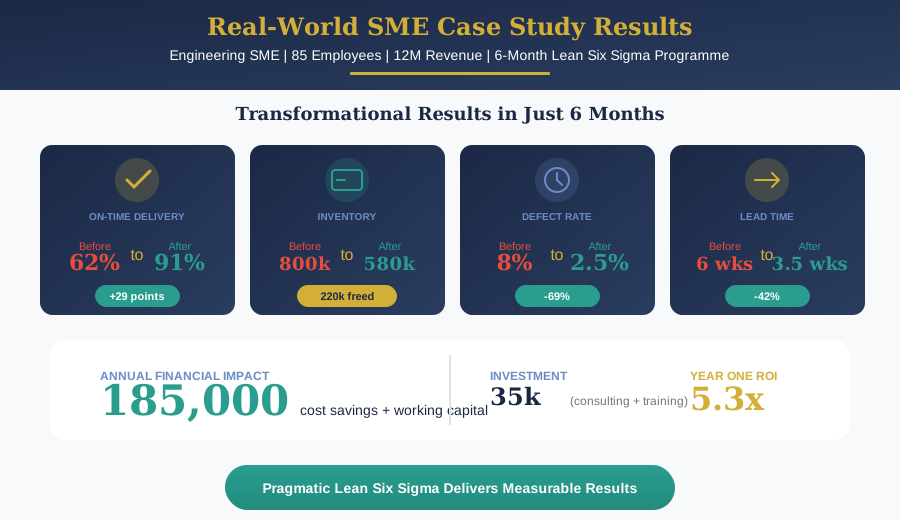
Client: Engineering SME, 85 employees, £12m revenue
Challenge: Low on-time delivery (62%), high inventory (£800k tied up), frequent quality issues
Approach (Right-Sized Lean Six Sigma):
Month 1: Quick Wins
- 5S in workshop and stores → 2 hours/day saved searching for tools and materials
- Visual scheduling board → improved visibility into workflow bottlenecks
- Gemba walks identified 12 quick fixes (£8k immediate savings)
Months 2-4: Targeted Projects
- Project 1: Reduce machining defects (used Pareto analysis + fishbone) → defect rate dropped from 8% to 2.5%
- Project 2: Reduce changeover times (SMED) → average changeover cut from 3.5 hours to 1 hour
- Project 3: Optimise inventory (Kanban system for high-runners) → inventory reduced by £220k
Results After 6 Months:
- On-time delivery: 62% → 91%
- Inventory: £800k → £580k (£220k working capital released)
- Defect rate: 8% → 2.5%
- Lead time: 6 weeks → 3.5 weeks
- Annual financial impact: £185k (cost savings + working capital release)
Investment: £35k (consultant support, training, visual management tools)
ROI: 5.3x in year one
Training and Capability Building: Keep It Practical
SMEs don't need formal Green Belt or Black Belt certifications. Instead:
- Executive Awareness (Half-day): Leadership understands principles, commits to support
- Frontline Practitioner Training (2 days): Practical workshops on 5S, value stream mapping, Pareto, fishbone, basic problem-solving
- Project Leader Training (3-5 days): DMAIC-lite, project management, facilitation skills for those leading improvement projects
- On-the-Job Coaching: External support for first 2-3 projects, then internal capability takes over
Total investment: £10k-£30k depending on size. Far less than formal belt programmes and more effective for SMEs.
Measuring Success: The KPIs That Matter
Track these metrics to demonstrate value:
- Financial: Cost savings, revenue increase, working capital release
- Operational: OEE, defect rates, on-time delivery, lead time, inventory turns
- Cultural: Number of improvement ideas submitted, participation rate, project completion rate
Review monthly. Adjust approach based on what's working.
Conclusion: Excellence Without Bureaucracy
Lean Six Sigma principles are universal, but the implementation must be right-sized for SMEs. Strip away the bureaucracy, accelerate the pace, focus on financial results, and build practical capability.
The SMEs that win are those that:
- Start small, prove value fast
- Use tools pragmatically (not dogmatically)
- Engage frontline staff (not just management)
- Link every project to financial impact
- Build sustainable capability (not consultant dependence)
You don't need a massive bureaucracy to achieve operational excellence. You need discipline, focus, and the right tools applied intelligently.